
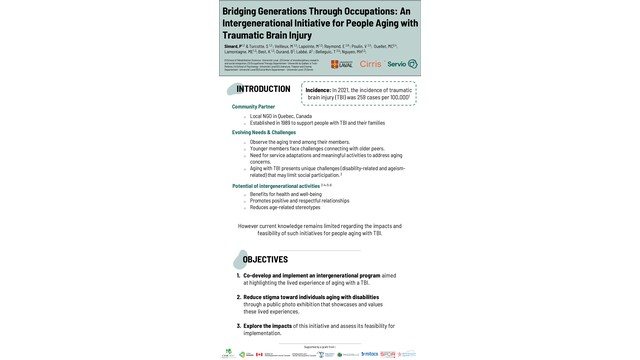
Introduction/Rationale: Social participation (SP) is increasingly recognized as a key determinant of health and successful aging. As they age, individuals with traumatic brain injury (TBI) often face challenges in SP due to ageism and disability-related stigma. Interventions addressing these challenges are limited. Intergenerational activities, with the potential to improve health, promote positive attitudes toward aging, and create opportunities for meaningful occupations, can foster the social participation of people with TBI.
Objectives: This presentation outlines the co-design process of an intergenerational initiative for people aging with TBI.
Methods/Approach: A participatory study using a Design Thinking approach was used to co-design the initiative through six 2-hour workshops. Participants included four individuals with TBI from two generations (18-35 and 55+ years old), three community workers from a community organization supporting SP of people with TBI, and two professional photographers from Quebec, Canada. Workshops featured activities like brainstorming, art creation, group discussions, testing, and prototyping.
Results/Practice implications: The process yielded an intergenerational initiative focusing on life story creation for people with TBI, presented through photography. The program consists of seven sessions, concluding with a photo exhibition in a national museum. A pairing tool for intergenerational duos was also developed. Key lessons learned include the importance of adaptive communication, maintaining flexibility, and harnessing intergenerational connections throughout the co-creation process.
Conclusion/Contribution to the occupational therapy profession: Our participatory approach and resulting initiative aim to promote social connection and potentially reduce stigma, exploring how occupation-based interventions and co-design can support social participation for people aging with TBI.