
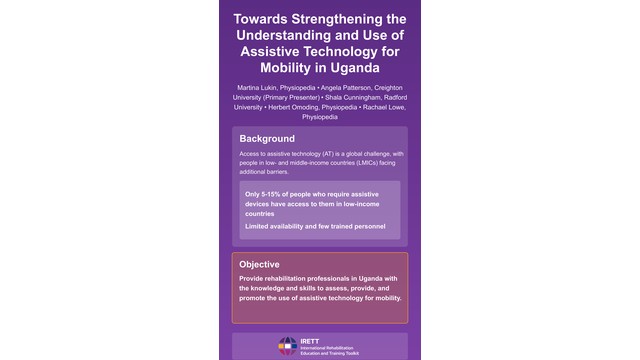
Background: Access to assistive technology (AT) is a global challenge, however people living in low- and middle-income countries (LMICs) face additional challenges. The WHO Community-Based Rehabilitation Guidelines indicate only 5–15% of people who require assistive devices and technologies have access to them in low-income countries, availability is often limited, and there are few trained personnel.
Objective: The purpose of the program was to provide rehabilitation professionals with the knowledge and skills to assess, provide, and promote the use of AT in Uganda.
Methods: Participants engaged in a hybrid training approach with online coursework, asynchronous online discussions, online synchronous mentoring sessions, and in-person training. To assess effectiveness of the training, participants completed surveys on their self-perception of knowledge and implementation of skills related to the assessment and prescription of AT . In addition, participants were invited to participate in focus group interviews to discuss their experience.
Results: Although mean scores on the surveys increased from initiation to completion of the training, there were no statistically significant changes in perception. During focus group interviews participants explained there was limited access to AT in the country however, the course inspired them to look at the equipment available creatively.
Conclusion: Although the education through the clinical training did not affect access, it promoted the use of available AT to support mobility. The mentors provided examples of how to adapt available equipment and supplies to guide participants to focus on the intent of the device and how they could replicate the function with materials available.