
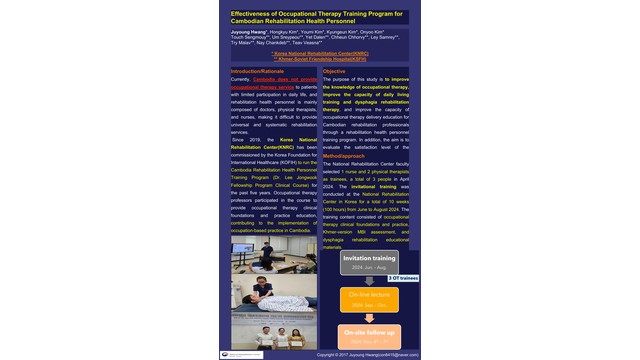
Introduction: Currently, Cambodia does not provide occupational therapy to patients with limited participation in daily activities. The Korea National Rehabilitation Center (KNRC) has performed the Cambodia Rehabilitation Health Personnel Training Program which is funded by Korea Foundation for International Healthcare (KOFIH). Occupational therapy faculty participated in the program to provide occupational therapy education, contributing to the implementation of occupation-based practice in Cambodia.
Objectives: The purpose of this study is to improve the knowledge of occupational therapy and the capacity of daily living training, dysphagia therapy for Cambodian experts through the training program.
Methods: The invitational training was conducted for 3 trainees at the KNRC for a total of 10 weeks (over 100 hours) from June to August 2024. The training consisted of occupational therapy foundations, occupation-based practice and dysphagia therapy. Also, the KNRC faculty conducted online training on OT foundations and ADL to nurses and physical therapists and visited Cambodia to conduct inspections, training in November. The evaluation consisted of the trainees’ OT knowledge, satisfaction level and work capacity, each of which was scored out of 100 points.
Results: The trainee OT knowledge evaluation score improved from 28 points to 84.7 points, and the education satisfaction was scored at 81 points. The faculty confirmed work capacity that the trainees improved the dressing, personal hygiene, and eating performance of 18 patients. In addition, the most significant improvement is the first implementation of Neuromuscular Electronic Stimulation (NMES) therapy and 17 out of 39 patients with dysphagia were improved diet level.
Conclusion: This training program not only provided Cambodian rehabilitation experts with the cornerstones for improving their occupational therapy knowledge and potential, implementing occupation-based practice, also contributed to improving Cambodian patient’s daily activities participation. Therefore, occupational therapists should provide much support and exchange to countries with limited occupational therapy to occupational justice implementation.