
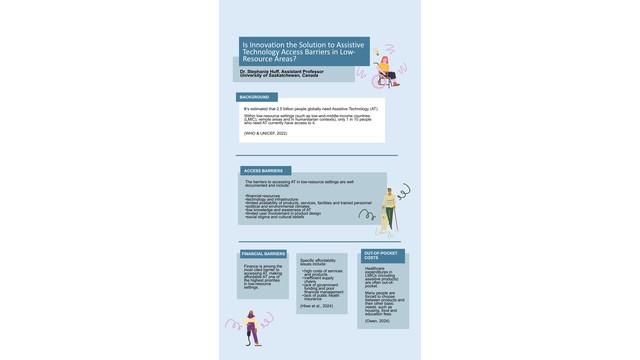
Introduction: It’s estimated that 2.5 billion people globally need Assistive Technology (AT). Yet, within low-resource settings (such as low-and-middle-income countries, remote areas and humanitarian contexts), only 1 in 10 people who need AT currently have access to it.
Objectives: This paper seeks to explore innovative and context-specific facilitators, such as novel systems pathways or delivery models and the advancement of digital technology, to bridge persistent barriers to AT access in low-resource settings. Within this aim, considerations and cautions of usage, such as widening the digital divide, are also unpacked to prioritize equitable AT access for all.
Approach: The Global Report on AT (2022) frames this paper, therefore the literature review focused on scholarship on AT access in low-resource settings from 2022 to present. Intersectional and social justice theoretical lenses were applied to the interpretation of data.
Practice implications: The findings illuminate several innovative and context-specific solutions to well-documented barriers to AT access in low-resource settings. Subsequent commentary expands on the importance of embedding context within AT provision and understanding intersectionality of AT users to appropriately meet AT need. Additional dialogue weighs the necessity of innovation within a systems approach to facilitating AT access, against the pragmatic considerations and cautions of usage.
Significance to the occupational therapy profession: The field of AT is advancing at a rapid rate, offering novel solutions to bridge existing AT access barriers in low-resource settings. It’s essential that the Occupational Therapy profession maintains competency around AT innovation, including both its potential benefits and cautions of usage.