
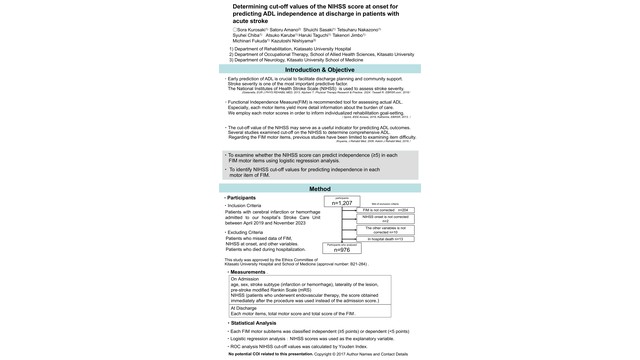
Introduction/Rationale: The length of hospital stay for acute stroke patients has been shortening lately in Japan. Occupational therapists must assess patients’ prognosis for Activities of Daily Living (ADL) at the early stage. Stroke severity, evaluated using the National Institutes of Health Stroke Scale (NIHSS), plays a key role in predicting outcomes.
Objectives: This study aimed to identify NIHSS cut-off values for predicting independence in each motor item of Functional Independence Measure (FIM).
Methods/Approach: Patients with cerebral infarction or hemorrhage admitted to our hospital’s Stroke Care Unit between April 2019 and November 2023 were included. Each score was classified at discharge as independent (≥5 points) or non-independent (<5 points). Logistic regression analysis was conducted using NIHSS scores at onset as the explanatory variable, and receiver operating characteristic (ROC) analysis was performed to calculate NIHSS cut-off values. Ethical approval was obtained.
Results: Total of 975 patients were analyzed, with a mean age of 71.5±13.6 years. Among them, 742 (76.1%) had cerebral infarction. The mean NIHSS score was 10.1±9.0, and the mean FIM motor item score was 58.1±30.4, respectively. Logistic regression analysis revealed significant associations between NIHSS scores and FIM motor items. ROC analysis showed areas under the curve (AUC) exceeding 0.8 for all items. Cut-off values were 12 points for eating, 11 points for grooming and bowel management, 8 points for bladder, and 6 points for the remaining items.
Conclusion: NIHSS scores at onset can effectively predict independence in FIM motor items, providing valuable insights for early-stage rehabilitation planning for stroke patients.